Result
Batih massacre
Batih massacre
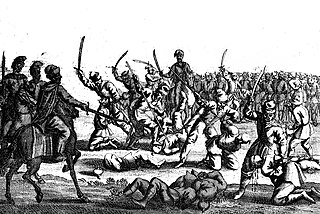
20/02/2022 14:39:09The Batih (Batoh) massacre (Polish: Rzeź polskich jeńców pod Batohem) was a mass execution of Polish captives after the Battle of Batih on 3–4 June 1652 near Ladyzhyn (now in Ukraine). It was carried out by Ukrainian Cossacks under the command of Hetman Bohdan Khmelnytsky.
Initially the captured Polish soldiers belonged to the Cossacks' allies, the Crimean Tatars. After the battle, the Cossacks paid the Tatars for possession of the prisoners, and promptly slaughtered the Polish captives to avenge Khmelnystsky's defeat at Berestechko in June 1651. According to Jasienica, it was the Cossack colonels Ivan Zolotaryenko and Ivan Vysochin who bought them from the Tatars. According to Widacka, Cossack's commander Khmelnystsky himself contributed 50,000 thalers for that purpose. According to Gruševskij, Pasicznyk, Duda and Sikora, the decision to execute the prisoners was made by Khmelnytsky himself. Afterward, between 3,000 and 5,000 elite Polish soldiers and officers, including 3,500 members of szlachta, were tied up and massacred in two days of methodical beheadings and disembowelments. Zolotaryenko supervised the executions yelling "Revenge for Berestechko!", a reference to an earlier Cossack defeat at the hands of the Poles in the Battle of Berestechko. The number of survivors of the pogrom is unknown.
...Zhang Xianzhong

Zhang Xianzhong
20/02/2022 14:39:08Zhang Xianzhong (张献忠 or Chang Hsien-chung; 18 September 1606 – 2 January 1647), nickname Huanghu (literally 'Yellow Tiger'), was a leader of a peasant revolt from Yan'an wei, Shaanxi (today Yulin, Shaanxi province). He conquered Sichuan in 1644, and named himself king and later emperor of the Xi dynasty (西朝 or Great Xi 大西). His rule in Sichuan was brief, and he was killed by the invading Qing army. He is commonly associated with the massacres in Sichuan that depopulated the region. However, the extent of his killings is disputed.
Yangzhou massacre
Yangzhou massacre
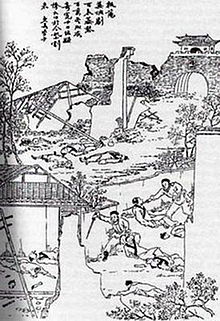
20/02/2022 14:39:07The Yangzhou massacre in May, 1645 in Yangzhou, Qing dynasty China, refers to the mass killings of innocent civilians by Manchu and defected northern Ming soldiers, commanded by the Manchu general Dodo.
The massacre is described in a contemporary account, A Record of Ten Days in Yangzhou, by Wang Xiuchu. Due to the title of the account, the events are often referred to as a ten-day massacre, but the diary shows that the slaughter was over by the sixth day, when burial of bodies commenced. According to Wang, the number of victims exceeded 800,000, that number is now disproven and considered by modern historians and researchers to be an extreme exaggeration. The major defending commanders of Ming, such as Shi Kefa, were also executed by Qing forces after they refused to submit to Qing authority.
The alleged reasons for the massacre were:
- To punish the residents because of resistance efforts led by the Ming official Shi Kefa.
- To warn the rest of the population in Jiangnan of the consequences of participating in military activities and resisting the Qing invaders.
Storming of Bolton
Storming of Bolton
20/02/2022 14:39:061643
- Braddock Down
- Leeds
- 1st Middlewich
- Hopton Heath
- Seacroft Moor
- Camp Hill
- Lichfield
- Ripple Field
- Reading
- Sourton Down
- 1st Wardour Castle
- Stratton
- Wakefield
- 1st Worcester
- Chalgrove Field
- Adwalton Moor
- Burton Bridge
- Lansdowne
- Roundway Down
- 1st Bristol
- Gainsborough
- Gloucester
- 2nd Hull
- Aldbourne Chase
- 1st Newbury
- Winceby
- Olney Bridge
- 1st Basing House
- Heptonstall
- 2nd Wardour Castle
- Alton
- Bramber Bridge
- Arundel
- 2nd Middlewich
Roman conquest of Anglesey
Roman conquest of Anglesey
20/02/2022 14:39:0677 CE

Anglesey within Wales.
| Date | 60 or 61 CE 77 CE |
|---|---|
| Location | |
| Result | Roman victory |
Agricola
Introduction
Portadown massacre
Portadown massacre
20/02/2022 14:39:05Irish Rebellion of 1641
Irish Rebellion of 1641
20/02/2022 14:39:04Indian massacre of 1622
Indian massacre of 1622
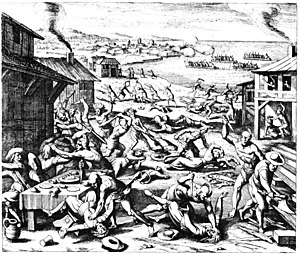
20/02/2022 14:39:01The Indian massacre of 1622, popularly known as the Jamestown massacre, took place in the English Colony of Virginia, in what is now the United States, on 22 March 1622. John Smith, though he had not been in Virginia since 1609 and was not an eyewitness, related in his History of Virginia that warriors of the Powhatan "came unarmed into our houses with deer, turkeys, fish, fruits, and other provisions to sell us". The Powhatan then grabbed any tools or weapons available and killed all the English settlers they found, including men, women, and children of all ages. Chief Opechancanough led the Powhatan Confederacy in a coordinated series of surprise attacks; they killed a total of 347 people, a quarter of the population of the Virginia colony.
Jamestown, founded in 1607, was the site of the first successful English settlement in North America, and was the capital of the Colony of Virginia. Its tobacco economy, which quickly degraded the land and required new land, led to constant expansion and seizure of Powhatan lands, which ultimately provoked the massacre.
Junkersdorf massacre
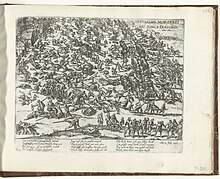
Junkersdorf massacre
20/02/2022 14:38:59The Junkersdorf massacre (3 July 1586) was an incident in the Cologne War of 1583–1588.
Siege of Smerwick
Siege of Smerwick
20/02/2022 14:38:58English victory
- Papal troops massacred
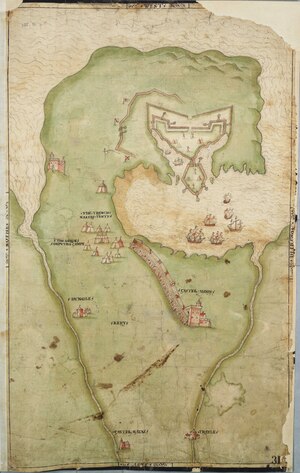
Map of the English attack on Spanish and Italian forces at Smerwick
| Date | 7–10 November 1580 |
|---|---|
| Location | Dún an Óir near Ard na Caithne, Ireland 52°11′25″N 10°24′56″W / 52.190386°N 10.415546°WCoordinates: 52°11′25″N 10°24′56″W / 52.190386°N 10.415546°W |
| Result |
English victory
|
.svg)
.svg)
 Papal States consisting of Spanish & Italian troops
Introduction
Clandeboye massacre
Clandeboye massacre
20/02/2022 14:38:57The Clandeboye massacre in 1574 was a massacre of the O'Neills of Lower Clandeboye by the English forces of The 1st Earl of Essex. It took place during an attempted English colonisation of Ulster as part of the Tudor conquest of Ireland. The Lord of Lower Clandeboye, Sir Brian McPhelim O'Neill, had violently opposed these attempts at colonisation. O'Neill would invite Lord Essex to parley at his castle in Belfast; however, at the end of the feast, the English forces turned on the O'Neills and killed up to 200 of them including women and children. Essex ordered that O'Neill, his wife and brother to be seized and executed for treason and for opposing the plantations.
Ottoman–Venetian War (1570–1573)
Ottoman–Venetian War (1570–1573)
20/02/2022 14:38:54The Fourth Ottoman–Venetian War, also known as the War of Cyprus (Italian: Guerra di Cipro) was fought between 1570 and 1573. It was waged between the Ottoman Empire and the Republic of Venice, the latter joined by the Holy League, a coalition of Christian states formed under the auspices of the Pope, which included Spain (with Naples and Sicily), the Republic of Genoa, the Duchy of Savoy, the Knights Hospitaller, the Grand Duchy of Tuscany, and other Italian states.
The war, the pre-eminent episode of Sultan Selim II's reign, began with the Ottoman invasion of the Venetian-held island of Cyprus. The capital Nicosia and several other towns fell quickly to the considerably superior Ottoman army, leaving only Famagusta in Venetian hands. Christian reinforcements were delayed, and Famagusta eventually fell in August 1571 after a siege of 11 months. Two months later, at the Battle of Lepanto, the united Christian fleet destroyed the Ottoman fleet, but was unable to take advantage of this victory. The Ottomans quickly rebuilt their naval forces and Venice was forced to negotiate a separate peace, ceding Cyprus to the Ottomans and paying a tribute of 300,000 ducats.
...Battle of Cajamarca
Battle of Cajamarca
20/02/2022 14:38:50Conflicts between conquistadors and rebellions
End of the Neo-Inca state
Lisbon massacre

Lisbon massacre
20/02/2022 14:38:47The Lisbon massacre (alternatively known as the Lisbon pogrom or the 1506 Easter Slaughter) took place in April, 1506, in Lisbon in the Kingdom of Portugal. A crowd of Catholics, and foreign sailors who were anchored in the Tagus, persecuted, tortured, killed, and burnt at the stake hundreds of people who were accused of being Jews, and consequently deemed guilty of deicide and heresy. This incident took place thirty years before the establishment of the Portuguese Inquisition and nine years after the Jews were expelled in 1496 and forced to convert to the Catholic Church in 1497, during the reign of King Manuel I.
Brussels massacre

Brussels massacre
20/02/2022 14:38:46The Brussels massacre was an anti-Semitic episode in Brussels (then within the Duchy of Brabant) in 1370 in connection with an alleged host desecration at the Brussels synagogue. A number of Jews, variously given as six or about twenty, were executed or otherwise killed, while the rest of the small community was banished. The event occurred on May 22.
The supposedly recovered hosts became objects of veneration for local Christians as the Sacrament of Miracle. The cult survived until after the Second World War and the Holocaust, after which its antisemitic elements pushed the local church to derecognise it. It was claimed that the hosts had been stabbed by Jews and had miraculously shed blood, but been otherwise unharmed. The reliquary (without the hosts) is currently preserved in the cathedral's treasury (the hosts may have been present inside it as late as the year 2000).
...Crow Creek massacre
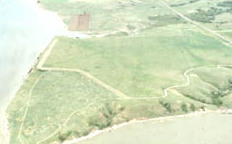
Crow Creek massacre
20/02/2022 14:38:45The Crow Creek massacre occurred around the mid-14th century CE between Native American groups at a site along the upper Missouri River in the South Dakota area; it is now within the Crow Creek Indian Reservation. Crow Creek Site, the site of the massacre near Chamberlain, is an archaeological site and a U.S. National Historic Landmark, located at coordinates 43°58′48″N 99°19′54″W. An excavation of part of the site was done in the 1950s, at the time of dam construction on the river. Additional excavations were conducted in 1978 and later.
Two groups occupied the site in prehistoric times. The Siouan-speaking Middle Missouri people (Initial Middle Missouri variant), ancestral to the historic Mandan people, first occupied the site sometime after about AD 900. They built numerous earth lodges on the lower portion of the site. Caddoan-speaking Central Plains people (Initial Coalescent variant) moved into the area from southern areas (present-day Nebraska) sometime around 1150 AD. (The historic Arikara are a Caddoan people.) Whether they displaced the earlier group or moved on to an abandoned site is unknown. The Central Plains (Initial Coalescent) people built at least 55 lodges, mostly on the upper part of the site. There is no direct evidence that there was conflict between the two groups, and scholars have found evidence that both cultures changed gradually in relation to the other.
...Sicilian Vespers
Sicilian Vespers
20/02/2022 14:38:43Reign of Frederick II
Post-Frederick II
Massacre at Béziers

Massacre at Béziers
20/02/2022 14:38:42Languedoc War
Languedoc Revolt
...Massacre of the Latins

Massacre of the Latins
20/02/2022 14:38:41The Massacre of the Latins (Italian: Massacro dei Latini; Greek: Σφαγὴ τῶν Λατίνων) was a large-scale massacre of the Roman Catholic (called "Latin") inhabitants of Constantinople, the capital of the Eastern Roman Empire, by the Eastern Orthodox population of the city in April 1182.
The Roman Catholics of Constantinople at that time dominated the city's maritime trade and financial sector. Although precise numbers are unavailable, the bulk of the Latin community, estimated at 60,000 at the time by Eustathius of Thessalonica, was wiped out or forced to flee. The Genoese and Pisan communities especially were devastated, and some 4,000 survivors were sold as slaves to the (Turkish) Sultanate of Rum.
...Siege of Jerusalem (1099)
Siege of Jerusalem (1099)
20/02/2022 14:38:40The Siege of Jerusalem (7 June – 15 July 1099) was waged by European forces of the First Crusade, resulting in the capture of the Holy City of Jerusalem from the Muslim Fatimid Caliphate, and laying the foundation for the Christian Kingdom of Jerusalem, which lasted almost two centuries. The capture of Jerusalem was the final major battle of the first of the Crusades to liberate and occupy the Holy Land begun in 1095. A number of eyewitness accounts of the siege were recorded, the most quoted being that from the anonymous Gesta Francorum. Upon the declaration of the secular state, Godfrey of Bouillon, prominent among the leaders of the crusades, was elected ruler, eschewing the title "king." The siege led to the mass slaughter of thousands of Muslims and Jews and to the conversion of Muslim holy sites on the Temple Mount into Christian shrines.
...1033 Fez massacre
1033 Fez massacre
20/02/2022 14:38:37In 1033, following their conquest of the city from the Maghrawa tribe, the forces of Tamim, chief of the Zenata Berber Banu Ifran tribe, perpetrated a massacre of Jews in Fez in an anti-Jewish pogrom. The city of Fez in Morocco had been contested between the Zenata Berber tribes of Miknasa, Maghrawa and Banu Ifran for the previous half century, in the aftermath of the fall of the Idrisid dynasty.
Tamim's forces killed over six thousand Jews, appropriated their belongings, and captured the Jewish women of the city. The killings took place in the month of Jumaada al-Akhir 424 AH (May–June 1033 AD). The killings have been called a "pogrom" by some recent writers. Sometime in the period 1038-1040 the Maghrawa tribe retook Fez, forcing Tamīm to flee to Salé.
...Invasion of Banu Qurayza
Invasion of Banu Qurayza
20/02/2022 14:38:34The Invasion of Banu Qurayza took place in Dhul Qa‘dah during January of CE 627 (AH 5) and followed on from the Battle of the Trench (Muir, 1861).
The Banu Qurayza initially told the Muslims that they were allied to them during the Battle of the Trench, however, later they sided with the Pagan Arabs of Quraysh and their allies. According to traditional sources, Jewish leaders organized efforts against Muhammad and the Muslims. Three Jewish leaders from the tribe of Banu al-Nadir, three Jewish leaders from the tribe of Wa'il, and various other Jewish groups and leaders united and pressured Banu Qurayza to betray their agreement to Muhammad. Afzalur Rahman states that during the Battle of the Trench, when the Muslims were surrounded by a large hostile force, the Banu Qurayza joined the enemies of the Muslims and threatened the Muslims from within the town itself. Waqidi claims that Muhammad had a treaty with the tribe which was torn apart. Norman Stillman and Watt believe such a treaty was "doubtful" to have existed, though Watt believes the Qurayza had agreed not to assist Muhammad's enemies against him. According to Safiur Rahman Mubarakpuri, Peters, Stillman, Guillaume, Inamdar and Ibn Kathir, on the day of the Meccans' withdrawal Muhammad led his forces against Banu Qurayza. According to Muslim tradition he had been ordered to do so by God.
...Battle of Changping
Battle of Changping
20/02/2022 14:38:12The Battle of Changping (長平之戰) was a military campaign during the Warring States period of ancient China, which took place from 262 BC to 260 BC at Changping (northwest of present-day Gaoping, Shanxi province), between the two strongest military powers, the State of Qin and the State of Zhao. After a bitter two-year stalemate, the battle ended in a decisive victory to Qin army and the ruthless execution of most of the Zhao captives, resulting in an unrecoverable loss of manpower and strategic reserve for the Zhao state.
One of the bloodiest battles of human history, the main historical records for the events of this period is sourced from the Records of the Grand Historian, written more than a century later, which estimated roughly 450,000 dead on the Zhao side and 250,000 dead on the Qin side. Emperor Xuanzong of Tang (685–762) later built a temple over a collection of some of the human remains, and scattered bones and mass graves continue to be discovered on the site even to the present day.
...22 August 2015 Kabul suicide bombing
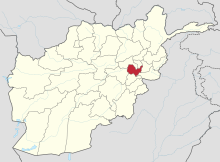
10 August 2015 Kabul suicide bombing
2009 bombing of Indian embassy in Kabul
2009 bombing of Indian embassy in Kabul
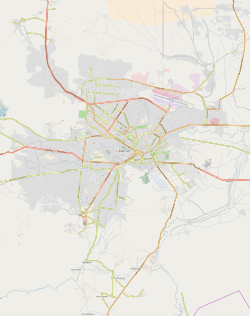
19/02/2022 17:10:54The 2009 Kabul Indian embassy bombing was a suicide bomb attack on the Indian embassy in Kabul, Afghanistan on 8 October 2009 at 8:30 am local time. The bombing killed 17 people and wounded 63.
2008 bombing of Indian embassy in Kabul

2021 Kabul hospital attack
2021 Kabul hospital attack
19/02/2022 17:10:49On 2 November 2021, a major insurgent attack occurred at the Sardar Mohammad Daoud Khan Military Hospital in Kabul, Afghanistan. At least 25 people were killed.
Fall of Kabul (2021)
